
Marketing Isn’t Broken — Your Sales System Is
Why Leads Come In but Sales Still Feel Random
If you’ve ever said “marketing isn’t working”, you’re not alone.
Business owners say it every day:
“Ads aren’t converting”
“Content isn’t bringing sales”
“We’re getting leads, but nothing consistent happens”
And on the surface, it feels true.
You’re spending money.
You’re posting content.
You’re getting attention.
Yet revenue still feels unpredictable.
Here’s the uncomfortable truth:
Marketing is probably not the problem.
What’s broken is the system underneath it.
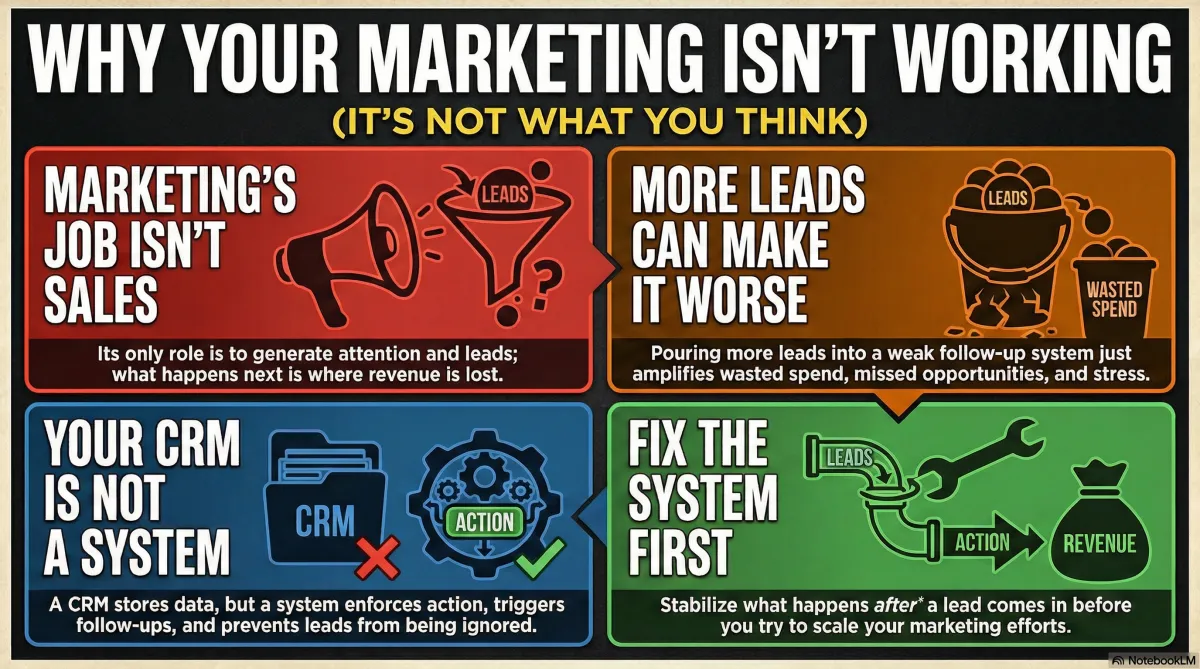
Marketing Does One Job — And It Usually Does It Well
Marketing has a very specific role:
👉 Bring attention.
👉 Create interest.
👉 Generate enquiries or leads.
That’s it.
Marketing is not responsible for:
how fast someone is contacted
how consistently they’re followed up
how calls are booked
how no-shows are handled
how undecided leads are nurtured
Yet these are the exact places where most businesses lose money.
When marketing “works,” it sends people into your business.
What happens next decides whether revenue is created or lost.
The Real Problem Starts After the Lead Comes In
Let’s walk through what usually happens.
A potential customer:
fills a form
sends a DM
clicks a WhatsApp button
books a call
Interest is high in that moment.
Then:
response is delayed
follow-up is manual
nobody owns the next step
the lead cools down
No alarm goes off.
No error message appears.
The opportunity simply disappears.
This is why revenue leaks are so dangerous — they’re silent.
Why More Marketing Often Makes Things Worse

When results feel inconsistent, the natural reaction is:
“Let’s get more leads.”
So businesses:
increase ad spend
post more content
hire agencies
add more channels
But if the system handling leads is weak, more leads don’t fix the problem.
They amplify it.
More leads + weak follow-up =
👉 more missed messages
👉 more no-shows
👉 more stress
👉 more wasted spend
This is why some businesses say:
“We ran ads and it didn’t work.”
In reality, the ads worked.
The system didn’t.
CRMs Are Not Systems (And This Confuses a Lot of People)
At this point, many business owners say:
“But we have a CRM.”
This is where an important distinction matters.
A CRM:
stores data
shows contact details
lists stages
A system:
enforces action
controls movement
triggers follow-up
prevents leads from being ignored
A CRM without rules is just a database.
It doesn’t:
chase leads
remind prospects
escalate hot opportunities
recover drop-offs
That’s why many businesses “have a CRM” but still lose leads daily.
Why Revenue Feels Random (Even When Sales Happen)
This is one of the biggest frustrations business owners feel.
Some months are good.
Some months are quiet.
There’s no clear reason why.
This happens when:
leads aren’t tracked properly
follow-up depends on memory
no one can see where deals get stuck
there’s no consistency in handling enquiries
When inputs are inconsistent, outputs will be too.
Predictable revenue doesn’t come from motivation.
It comes from structure.
What Actually Fixes This (And What Doesn’t)
Let’s be clear about what doesn’t fix the problem:
❌ More posting
❌ Better captions
❌ New ad creatives
❌ Hiring another agency
❌ Working harder
What fixes it is boring — but effective.
Systems that:
respond instantly
follow up multiple times automatically
move every lead through clear steps
flag hot opportunities
track what’s happening at each stage
When this exists:
marketing starts to look “better”
conversions increase without more traffic
stress goes down
decisions become clearer
Not because marketing changed —
but because the system did.
The Difference Between Chaos and Control
Businesses without systems feel like this:
reacting daily
guessing what’s working
chasing people manually
feeling anxious about cash flow
Businesses with systems feel like this:
calm
informed
repeatable
predictable
Predictability doesn’t mean growth stops.
It means growth becomes controllable.
And controllable growth is the only kind that scales.
Fix the System First. Then Scale Marketing.

This is the part most people get backwards.
They try to scale attention before they stabilise conversion.
The correct order is:
Fix what happens after leads come in
Make follow-up consistent
Track movement and drop-offs
Then increase traffic
When the system is solid, marketing finally feels like it’s “working.”
Because now, it is.
A Simple Way to Think About It
Marketing opens the door.
Systems decide who walks through.
If people keep knocking and no one answers, the door isn’t the problem.
Final Thought
If marketing feels frustrating, don’t immediately change platforms, agencies, or strategies.
Ask a better question:
“What happens to every lead after they raise their hand?”
The answer to that question explains most revenue problems.


Mail
Facebook
LinkedIn
X
Pinterest
Snapchat
Reddit