
Table of Contents
Mazhar Rajwani
Revenue Architect & Co-founder
Here's exactly how it happens. And exactly how to stop it.
You Built a Real Business. You Have the Customers. You Have the Reputation.
So why does it feel like you're constantly running to catch up?
Your food is good. Your regulars know it. Your Friday night lineup tells you the demand is there.
And yet — at the end of every month — the numbers don't quite reflect the effort you're putting in.
There's a reason for that.
And it has nothing to do with your food, your location, or the economy.
You're Open 12 Hours. Your Customers Are Active 24.
Right now — tonight — while your team is slammed during dinner service, something is happening that nobody on your staff will ever tell you about.
Calls are going unanswered.
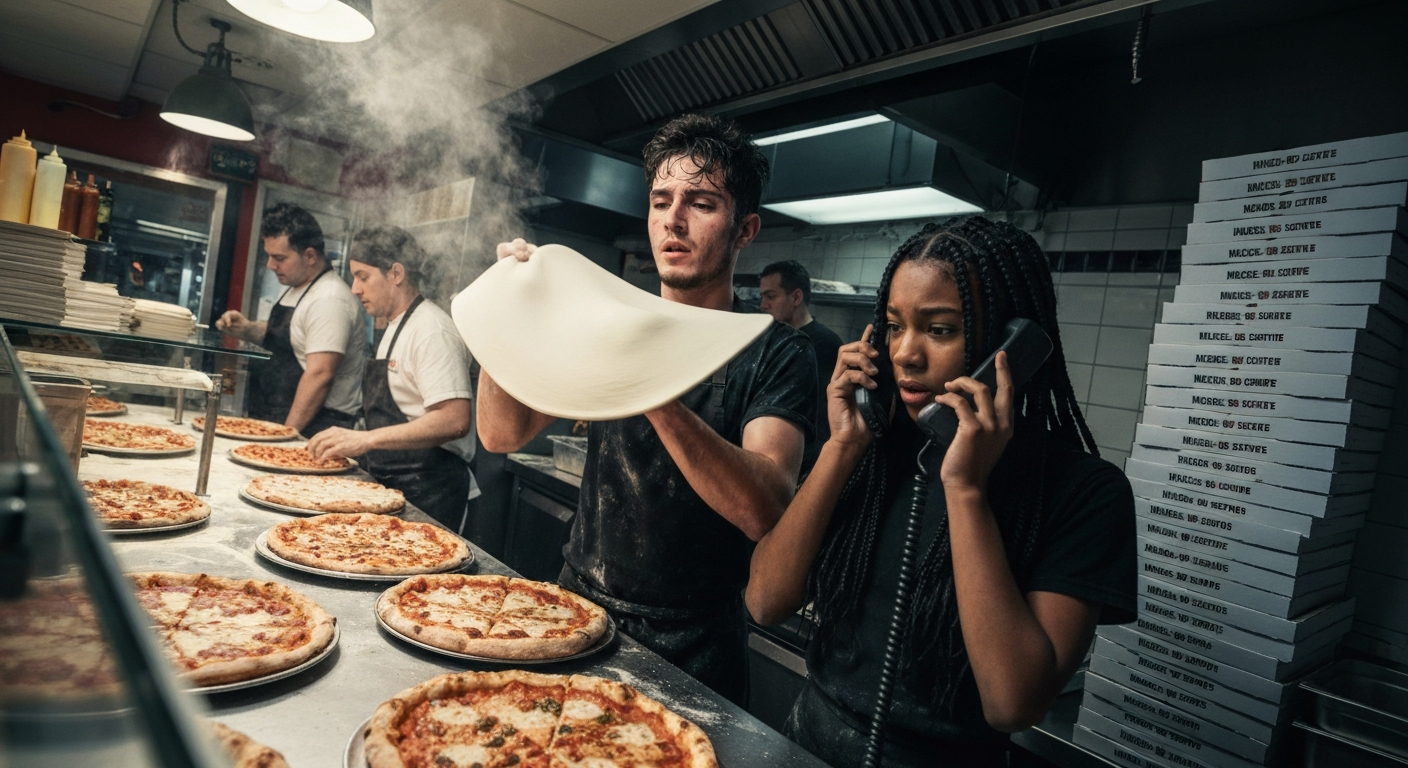
Not because your team doesn't care. Because they're making pizzas, running orders, managing the queue, and doing five things at once. The phone rings. Nobody can get to it. The caller waits. Then they hang up.
They don't leave a voicemail.
They open Google, find the next pizza shop on the list, and place their order there.
By the time your missed call notification shows up — they're already eating someone else's pizza.
And it's not just calls.
At 9:18pm on a Thursday, someone DMs your Instagram asking about a group booking for 14 people next Friday. Your team has gone home. The message sits there, unread, until the next morning.
By 9am — when someone finally sees it — that customer has already confirmed with a venue that replied in 90 seconds.
That was a $300+ booking. Gone. Not because you didn't want it. Because nobody was there.
And then there's the third problem. The one that's the most expensive and the most invisible.
You have customers who used to come in two or three times a week. They loved you. They knew your staff by name. They haven't been in for six, eight, ten weeks.
Nobody has reached out to bring them back. No message. No reason to return. Nothing.
Meanwhile, a competitor two streets away is sending monthly WhatsApp messages to their lapsed customers. "We miss you. Here's something for the weekend." Those customers — your former regulars — are quietly becoming someone else's regulars.
Let's Talk About What This Is Actually Costing You
Most pizza shop owners think about missed calls as a minor inconvenience.
They're not. They're a compounding revenue leak that gets worse every single week.
Here's the math nobody does out loud.
The average Toronto pizza order is worth $35–$65. A group booking runs $250–$400. A catering account — the office that orders lunch for 20 people every Friday — is worth $25,000 to $40,000 a year.
Now consider this: industry data puts missed calls at 35–50% of all inbound contacts during peak service hours. After close, on weekends, and during public holidays — it's effectively 100%.
That's not 35–50% of nothing. That's 35–50% of the customers who already wanted to give you money.
They found you. They liked what they saw. They reached out. And they were met with silence.
Here's what makes this worse.
Most of those customers don't try again. Research consistently shows that 70% of customers who don't reach a business on the first attempt confirm with a competitor the same day. They don't hold out hope. They move on.
So you're not just losing the order. You're losing the customer. Permanently.
And every week this continues — every Friday rush, every Saturday night, every closed Sunday when the catering enquiries come in — the gap between the revenue you could be making and the revenue you're actually making gets wider.
Now multiply that across 52 weeks.
$85,000.
That's a conservative estimate of what the average independent pizza shop in a busy Toronto market loses annually through missed calls, unanswered DMs, and lapsed customers who were never re-engaged.
That's not money you never had. That's money customers were actively trying to give you. Money that walked in the door and walked back out because nobody was there to catch it.
And here's the part that should bother you most:
Your competitor down the road is catching it.
Right now, while you're in service and your phone is ringing out, the pizza shop two minutes away is picking up. They're confirming the group booking. They're locking in the catering contract. They're texting the lapsed regular a reason to come back.
You didn't lose those customers because your food wasn't good enough.
You lost them because someone else replied first.
That's the entire problem. Not marketing. Not location. Not product.
Response speed.
The businesses winning local food markets right now are not necessarily the ones with the best pizza. They're the ones collapsing the delay between when a customer reaches out and when they get an answer.
What Happens When Every Call Gets Answered and Every Message Gets a Reply
What if none of that happened?
What if the next time someone called during Friday dinner service — when every member of your team is flat out and the phone rings seven times before going silent — they got an answer?
Not a voicemail. Not a hold message. An actual conversation. Someone who knew your menu, knew your prices, could take their order, answer their questions, and confirm their booking.
What if the group booking DM that came in at 9pm on Thursday got a reply within 90 seconds? Your full group menu, your available dates, and a booking confirmation — sent automatically, while you were asleep.
What if the office manager who called on Friday morning at 8:47am during your busiest service period — enquiring about weekly catering for 20 people — was captured, followed up with, and converted into a $600-a-week recurring account?
What if every lapsed regular — every customer who used to come in twice a week and quietly drifted — received a personal message after six weeks of absence? Something warm, specific, in your voice. A reason to come back. And most of them did.
This is not a hypothetical. This is what happens when you install a customer-response system that runs 24 hours a day, 7 days a week, with or without your team being available.
We call it the HashThatTags AI system. And it was built specifically for hospitality businesses like yours.
Here's what it does.
It answers every call.
During service, after close, on weekends, on public holidays. The AI is trained on your menu, your specials, your tone of voice, your pricing, your hours. It sounds like your team — because it's been built around your business, not a generic script.
It sends an instant text to every missed call.
The moment a call goes unanswered, an automatic SMS fires back within seconds: "Hi, we just missed your call — how can we help?" Most people reply. Most of them place an order or book a table.
It handles every Instagram DM, Facebook message, and website enquiry.
Group bookings confirmed. Catering menus sent. Private event deposits collected. All automatically, in real time, regardless of what hour the message arrives.
It sends booking reminders.
Every reservation gets a 48-hour and 24-hour reminder via SMS or WhatsApp. No-shows drop. Cancellations come early enough to refill the table.
It re-engages your lapsed customers.
Customers who haven't visited in four to eight weeks receive a personalised message — a weekend special, an event, a reason to return — in your voice, automatically.
It hands over to your team when needed.
Anything that requires a human — a bespoke event, a difficult situation, a decision only you can make — gets flagged and passed through with full context. Nothing gets dropped.
The result: you stop losing money you've already earned the right to keep.
One of our clients — an independent cafe owner in Melbourne — captured a catering enquiry she would have missed completely on the second day after going live. The AI followed up with her menu automatically. She signed a weekly contract worth $600 a week. $31,200 a year. From one call she would have missed during a busy Friday morning.
Another operator woke up on a Wednesday morning to a confirmed private event booking and $150 already in her account. A customer had messaged on Instagram late on a Tuesday night asking about a baby shower for 25 people. The AI replied instantly, sent the private hire pack, answered every question, and collected the deposit. She was asleep the entire time.
A coffee shop in Manchester ran a re-engagement campaign to 300 customers who hadn't visited in six weeks or more. 140 of them replied. Most came in within two weeks. "These were people we thought had just moved on," the owner said. "Turns out they just needed someone to reach out."
This Is Not About Technology. It's About Revenue You've Already Earned.
You didn't build your pizza shop to become a technology company.
You built it to make great food, serve your community, and create something that lasts.
But the gap between the business you're running and the business you could be running — the $85,000 gap — isn't a food problem. It's a communication infrastructure problem.
Your customers are reaching out. Right now. Tonight. Over the weekend. During your busiest service hours when your team can't get to the phone.
Some of them are getting through.
The rest are going somewhere else.
The fix isn't more marketing. It's not more staff. It's not longer hours.
It's a system that catches every customer who reaches out — at any hour, on any platform — and makes sure they never have to go somewhere else to get an answer.
Here's What to Do Right Now
Call +1 431 430 9950 and speak to our AI agent live.
Same one we'd set up for your shop. Ask it anything. Pretend you're a customer. Try to confuse it.
Most pizza shop owners are surprised. Usually takes about 90 seconds before they stop thinking about the technology and start thinking about the orders they've been missing.
No sales call. No pitch. Just the agent doing what it does.
Or text "DEMO" to +1 431 430 9950 and we'll show you exactly how it works for a Toronto pizza shop like yours.
There's no obligation. No pressure. No commitment.
Just a real look at what your business looks like when nobody ever misses a call again.
HashThatTags builds AI customer communication systems for independent pizza shops and restaurants in Toronto. Setup takes days. Results start immediately.
Call +1 431 430 9950 or text DEMO on whatsapp to +1 431 430 9950.

Mazhar Rajwani
Revenue Architect & Co-founder
I build the end-to-end infrastructure that turns traffic into predictable, scalable revenue. Stop buying tactics, start building systems.
Not Theory. Not Credentials. Proof Under Real Conditions.